
What I Learned About AI Brand Visibility at Sitecore Symposium 2026
Last year at Sitecore Symposium, the big question was "what is agentic AI?" This year, the question moved from understanding the threat to acting on it. AI now decides whether your brand shows up before a buyer ever reaches your website. If an AI answer doesn't mention you, for a growing number of buyers you simply aren't on the list.
Sitecore made that point loud and clear with its acquisition of Scrunch, and it was the thread running through many of the sessions I attended. It was also the topic of the fireside chat I hosted with Lisa Saltsman (Icreon) and Rodrigo Peplau (MSQ DX): "Show Up or Get Left Out: Is Your Brand Visible When AI Answers?" Here's what I learned.
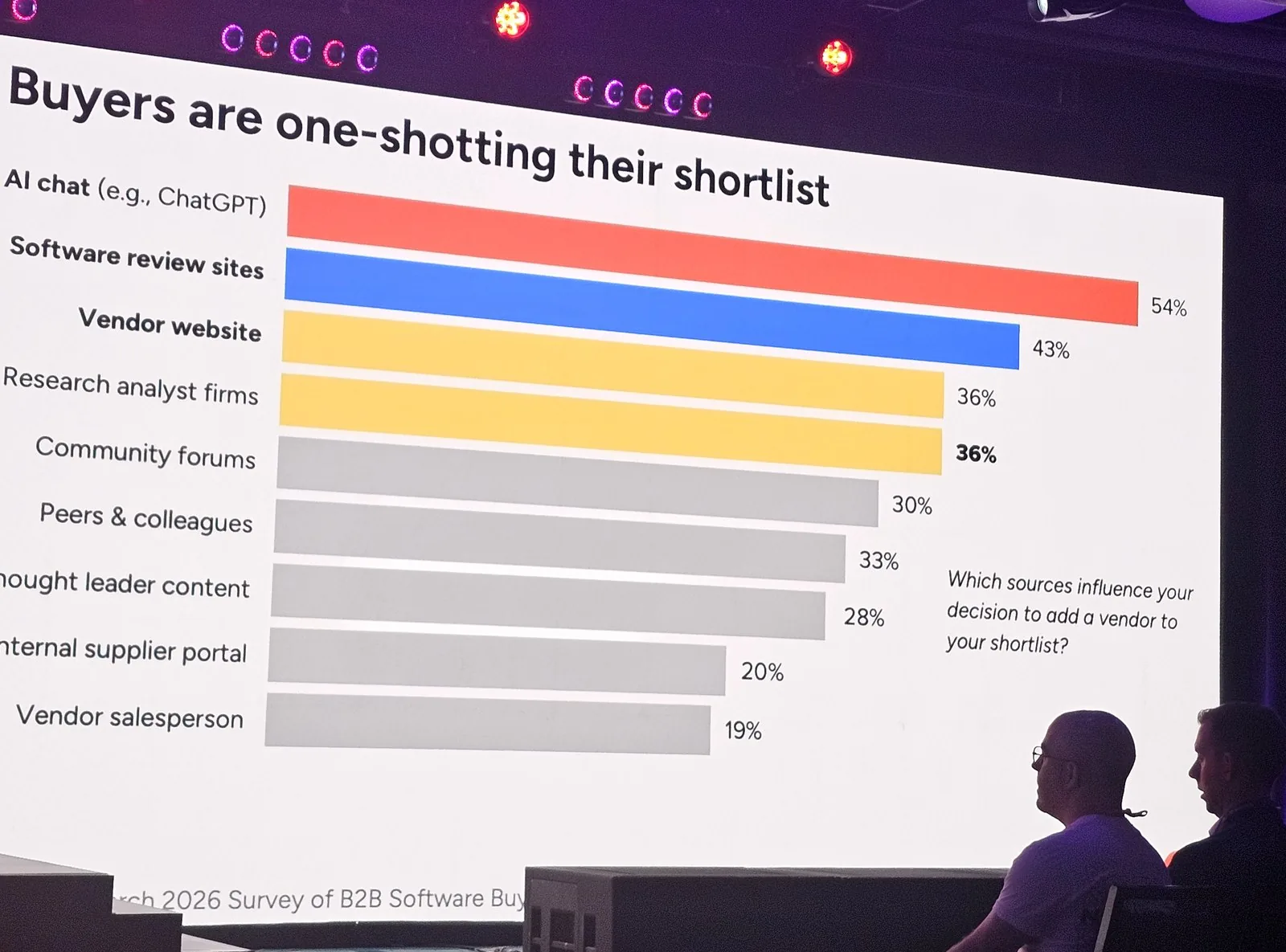
Buyers are one-shotting their shortlist
When B2B software buyers were asked which sources influence their decision to add a vendor to their shortlist, AI chat came out on top at 54%, ahead of software review sites (43%), the vendor's own website (36%), and research analyst firms (36%). The vendor salesperson came in last, at 19%.
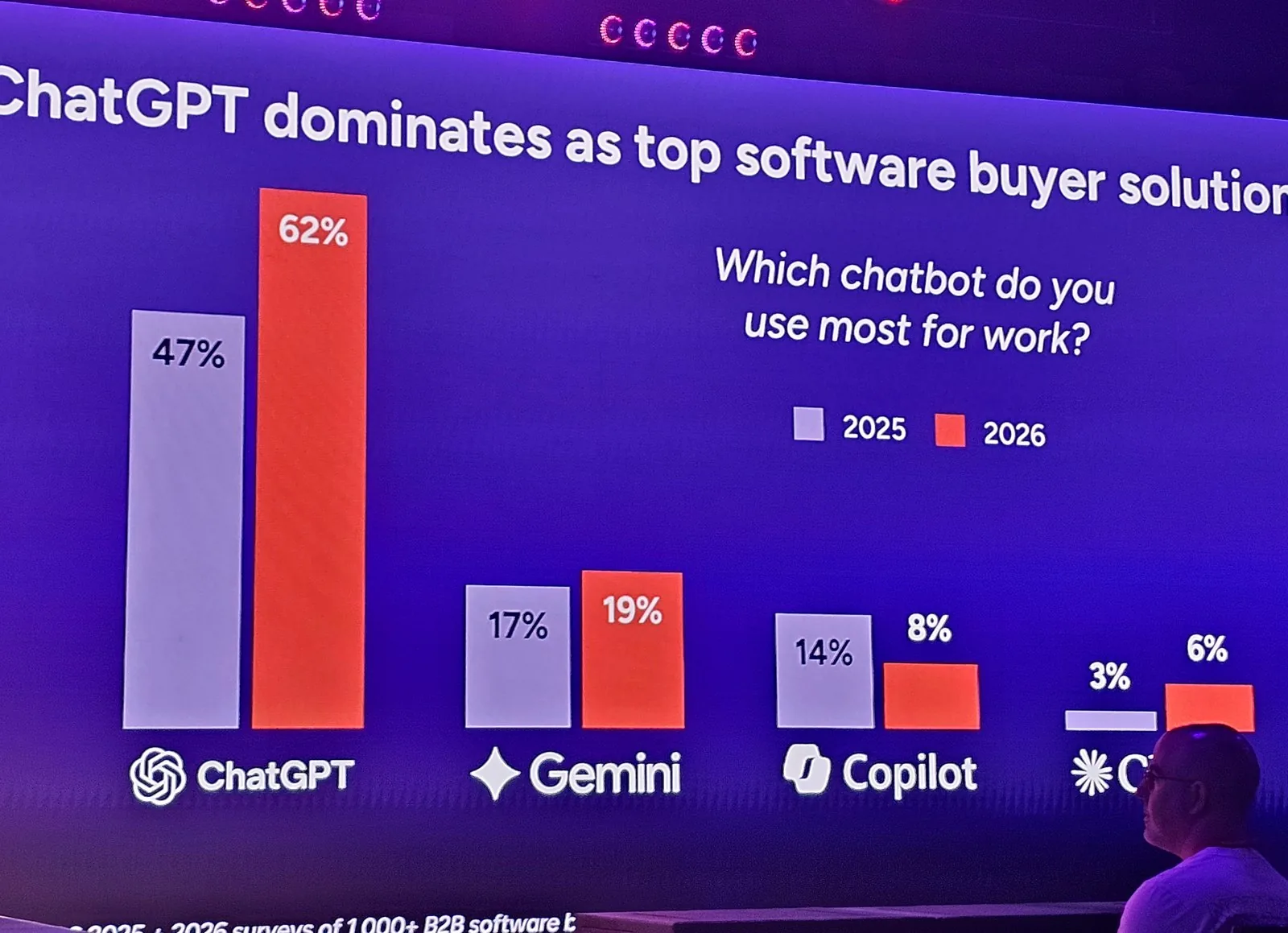
And one AI tool is pulling ahead. ChatGPT is the chatbot buyers use most for work, growing from 47% in 2025 to 62% in 2026, while Gemini sits at 19% and Copilot at 8%.
Searches have become conversations
The way people ask has changed, too. On Google, a buyer types a short-tail query like "best CRM for hospitals." In a chat prompt, the same buyer writes a paragraph: the problem they're solving, the devices their team uses, their budget, and even which vendors to exclude.
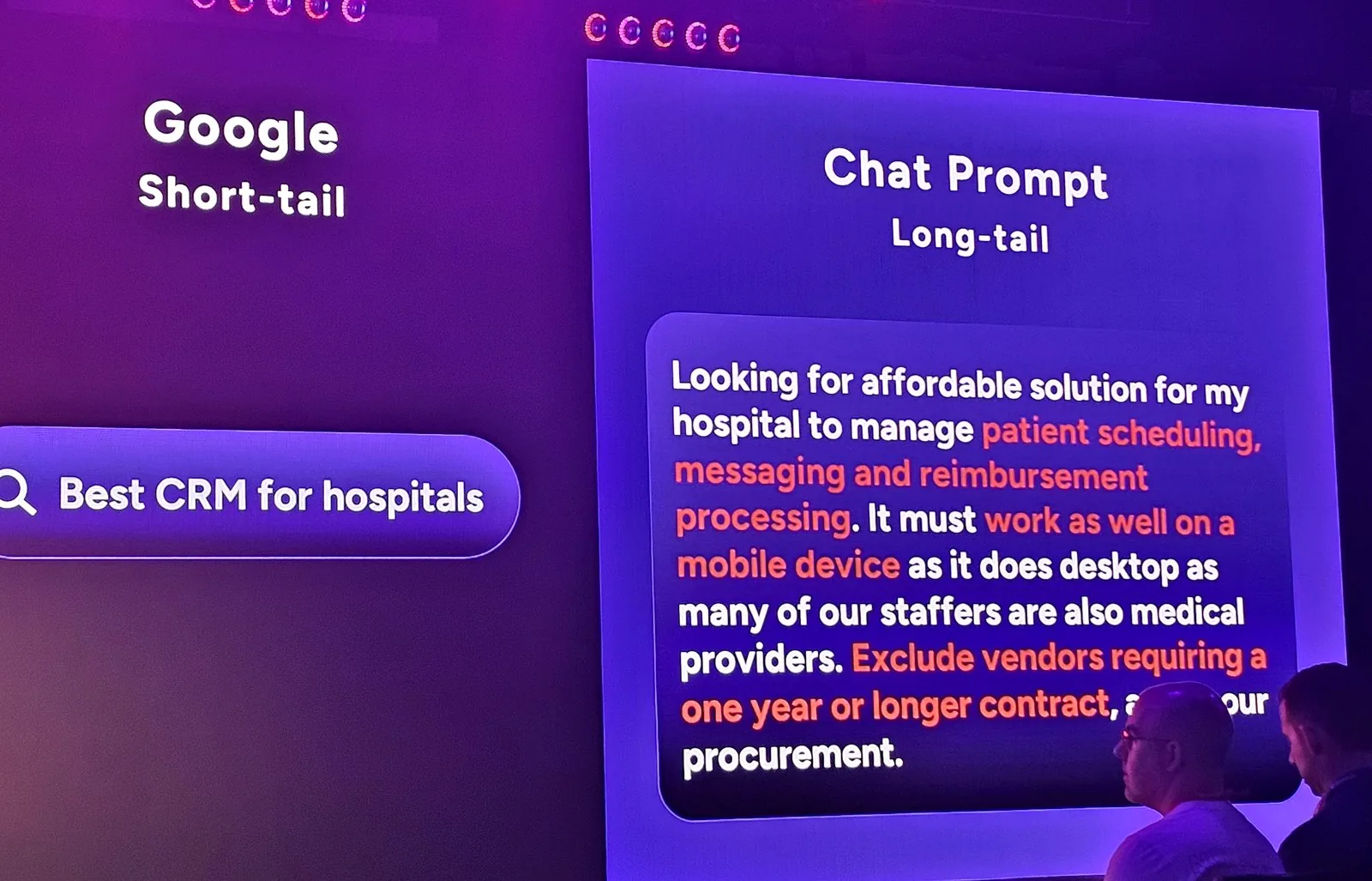
That creates what one speaker called the prompt problem: the misalignment between the prompts marketers track and the prompts users actually give LLMs. If you're only tracking your brand name or a few keywords, you're measuring the wrong thing. Your prompt panels are the foundation of your AEO (Answer Engine Optimization) efforts and your ROI analysis.
The fix is to build prompts the way your buyers think, using synthetic personas built around five things:
Job-to-be-done: what they're trying to accomplish
Constraints: time, risk, compliance, budget, and tooling
Vocabulary: how they naturally talk
Success metrics: their "good enough" definition
Decision criteria: the proof they need to trust and act
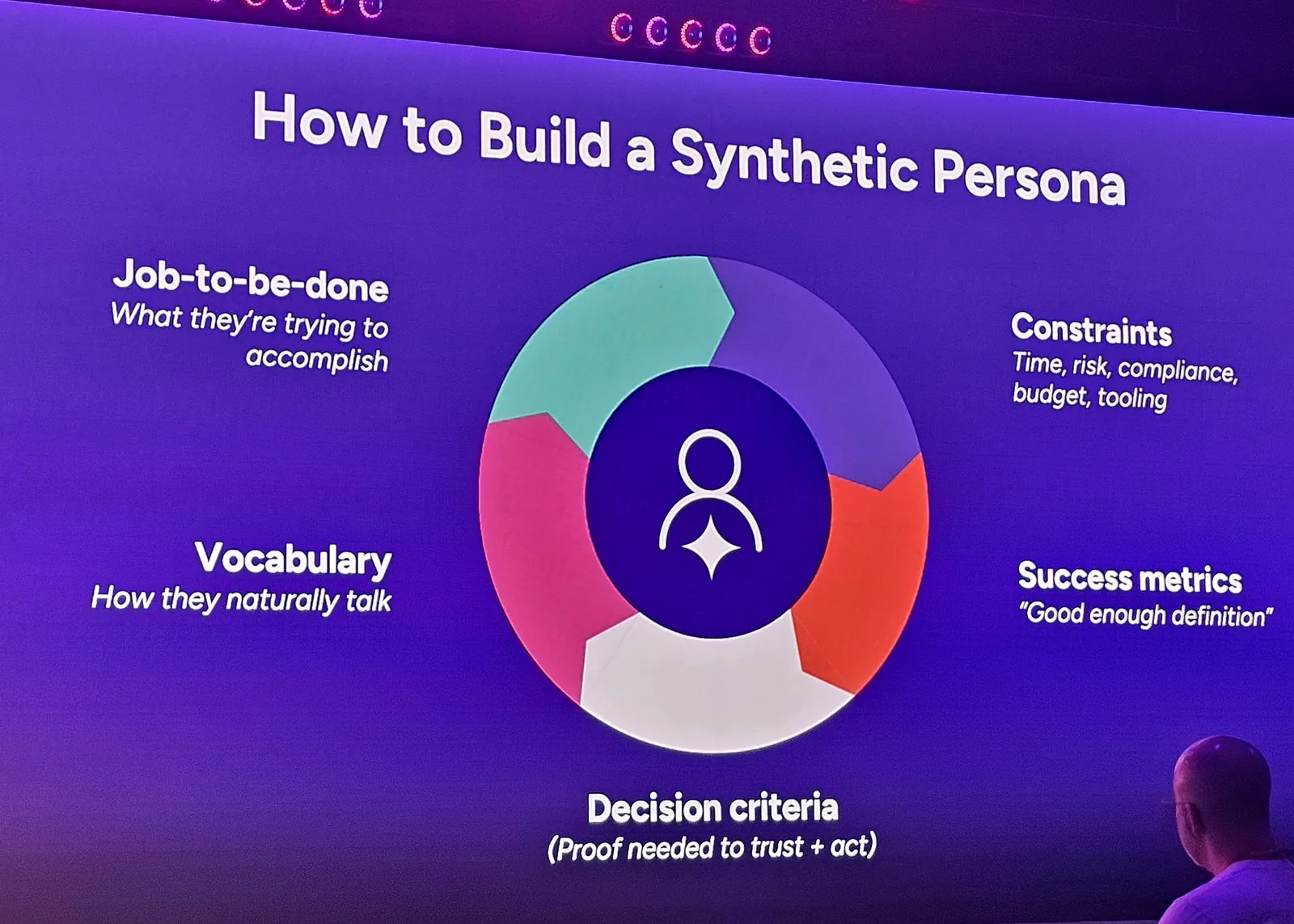
This one hit close to home. Personas have always been at the heart of good personalization, and now they're at the heart of AI visibility too. It's a big part of why we built AI engines into Persona Pulse as a channel, right next to search, social, email, and on-site.
How an LLM chooses what to recommend
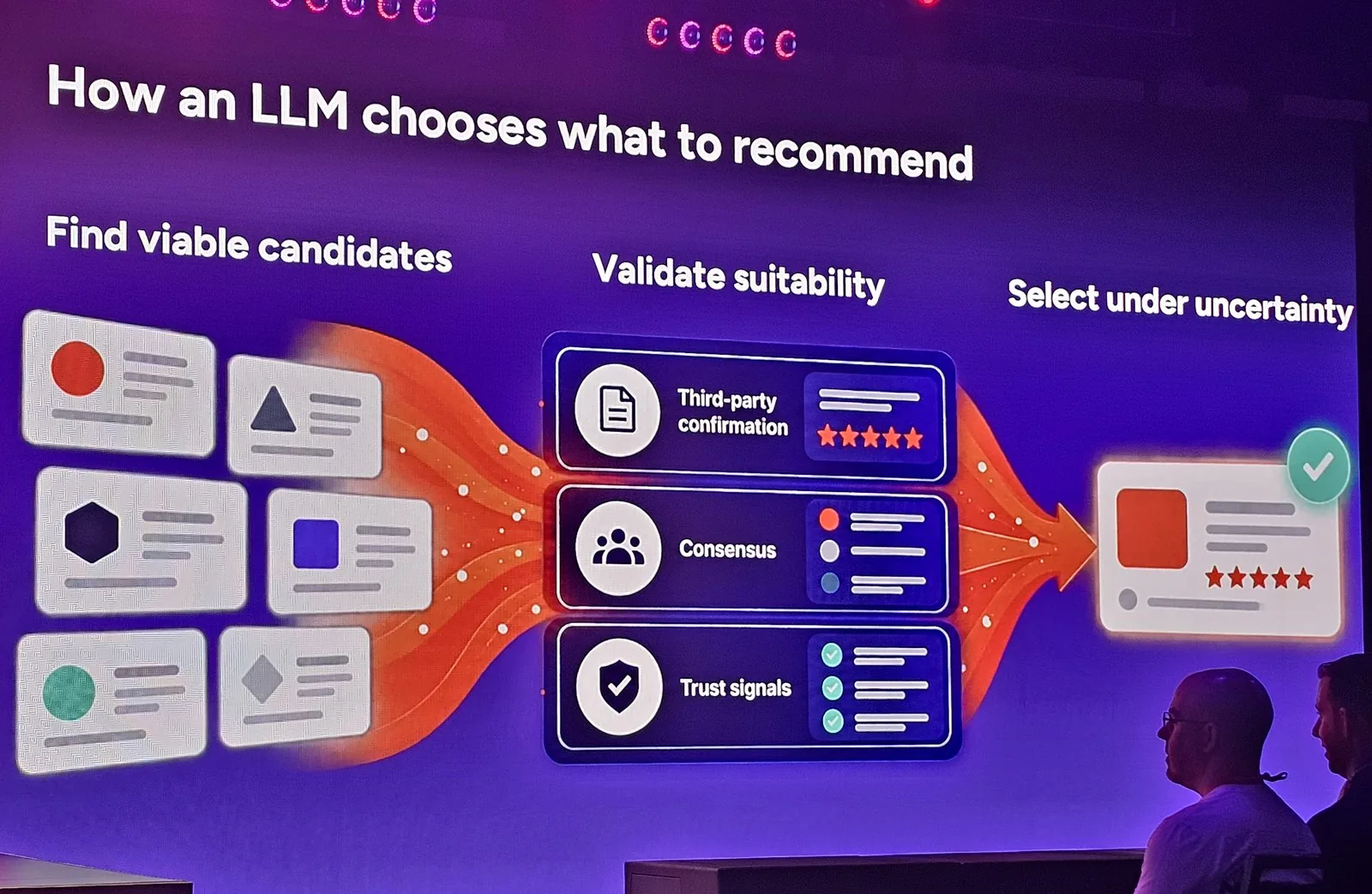
One of the most useful frameworks I saw broke an LLM's recommendation down into three steps:
Find viable candidates that could answer the question.
Validate suitability through third-party confirmation, consensus across sources, and trust signals.
Select under uncertainty, picking the option with the strongest evidence.
What does that evidence look like? According to research from Page Sage (March 2026), the biggest factor in ChatGPT's recommendations is authoritative list mentions (41%), followed by awards, accreditations, and affiliations (18%), online reviews (16%), customer examples and usage data (14%), and social sentiment (11%).
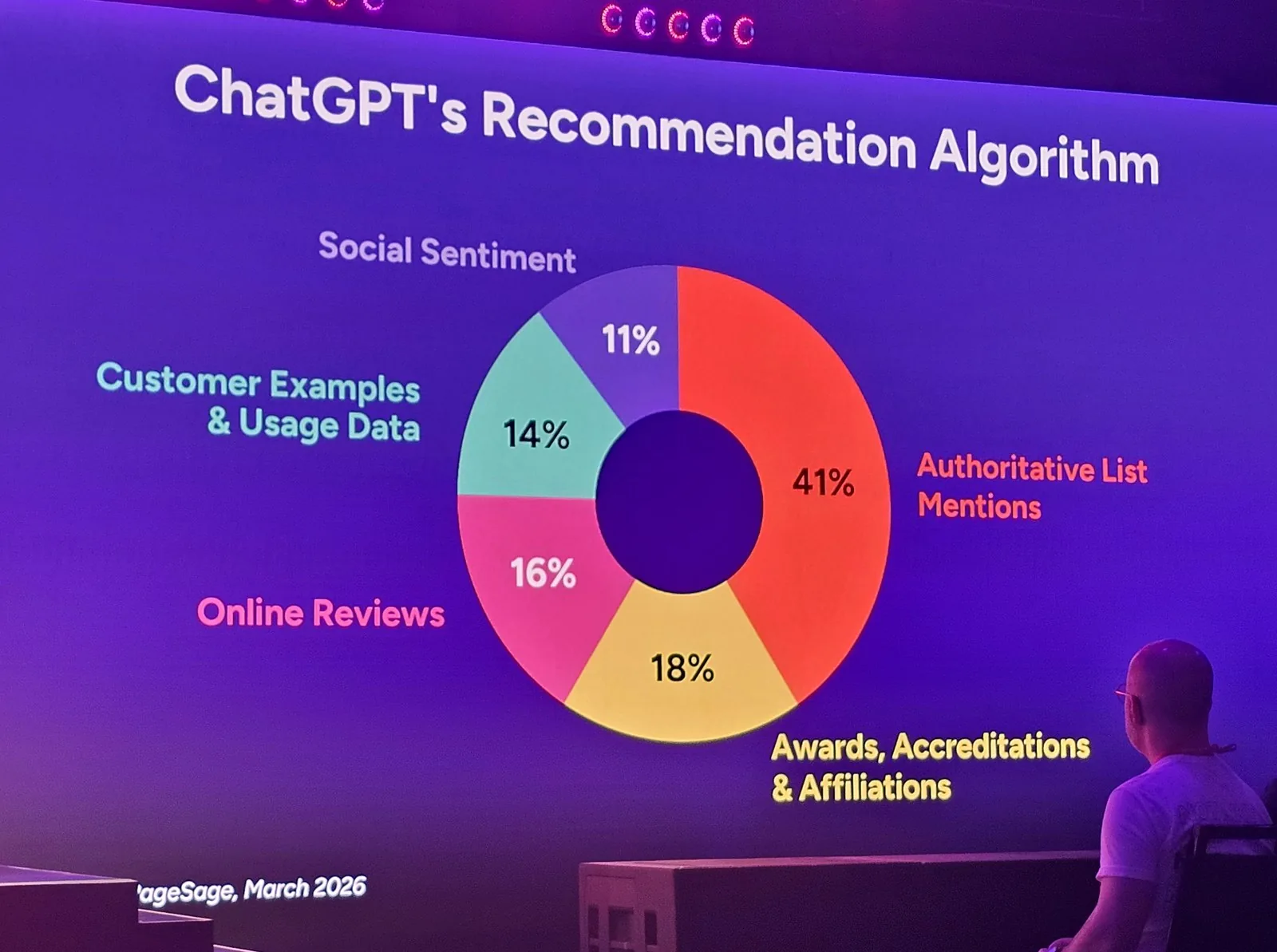
The takeaway: your own website matters, but what other people say about you matters more. Third-party proof is what gives an AI the confidence to recommend you.
What Scrunch means for Sitecore
Without the hype, here's why the Scrunch acquisition matters. Brands need a scalable way to see where they appear in AI answers, and to fix what's missing or wrong. Scrunch monitors how your brand shows up across AI platforms, and its Agent Experience Platform (AXP) serves AI agents a structured version of your existing content, so they read it accurately without changing the experience for humans.
The real shift is that AEO moves from a one-time audit to a continuous loop wired into your content workflow: see where you're invisible, fix the content in SitecoreAI, and measure again.
The practitioner reality check
In our fireside chat, Lisa and Rodrigo shared what they see in client rooms. Most marketing teams have no idea that AI may be misrepresenting them, or leaving them out entirely. There's usually a big gap between what a brand thinks AI says about it and what AI actually says. And fixing it is a content, technical, and strategy problem all at once.
The upside is real. Public examples shared in the session included Akamai, which reported a 364% lift in brand presence on non-branded prompts and 218% more citations, and Runpod, which reported a 400% increase in paying customers.
We also talked about who owns this. AI visibility work doesn't fit cleanly into marketing, SEO, content, or IT. Knowing you're invisible is one thing; having the workflow and the owner to fix it is another. That insight-to-action gap is exactly where SitecoreAI and Scrunch together can close the loop.
And we busted a few myths:
"SEO is dead, so none of this matters." Not true. Good SEO foundations, like crawlable pages, clear structure, and schema, are what AI builds on. AEO extends SEO; it doesn't replace it.
"More content means AI will find us." Volume isn't the answer. Clear, authoritative content that answers real questions, backed by third-party proof, is what gets cited.
"This only applies to B2C." The buyer data above is from B2B software buyers. If anything, B2B buyers are leaning on AI even harder to build their shortlists.
Where to invest
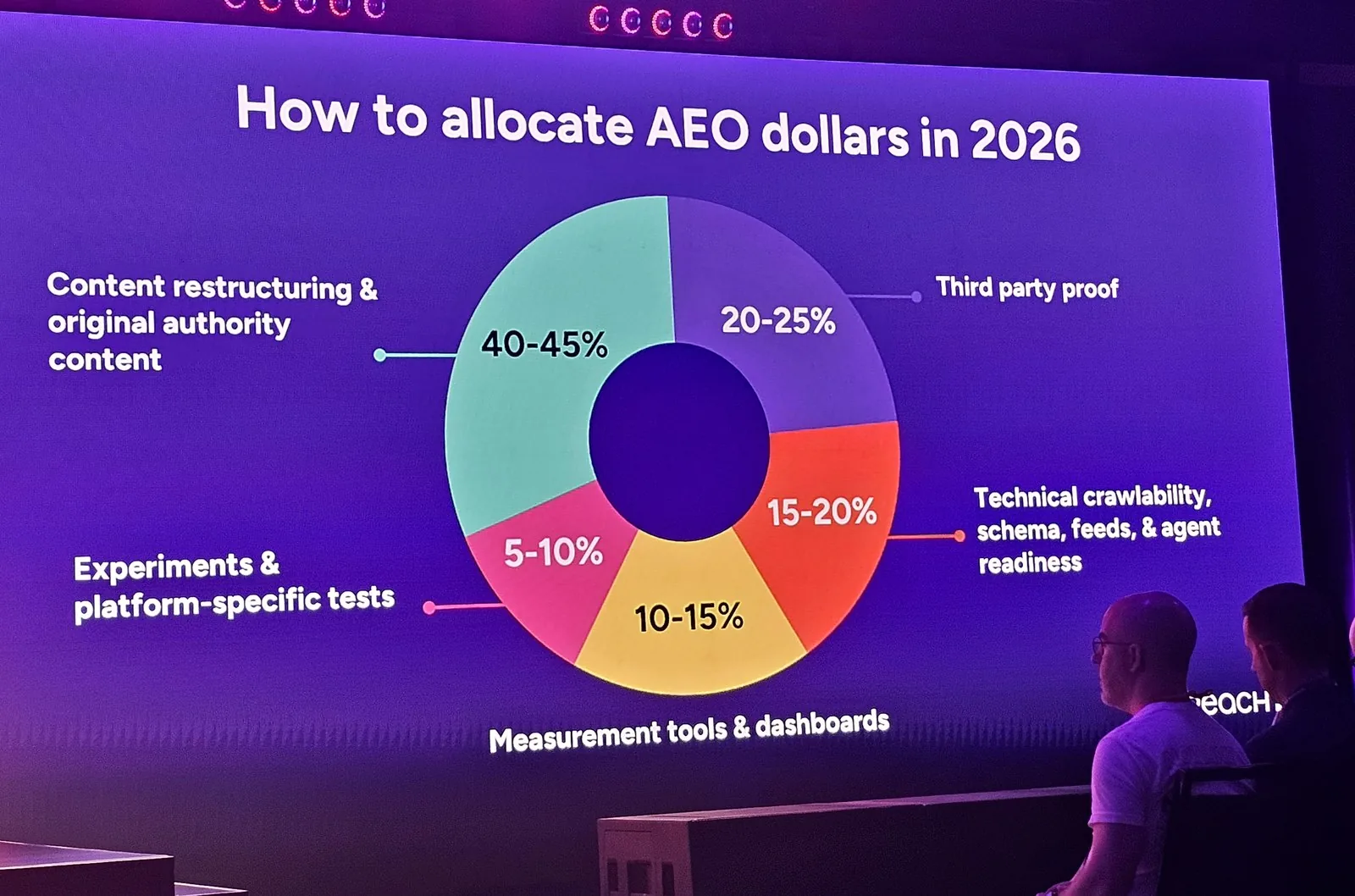
One session shared a practical guide to how to allocate AEO dollars in 2026:
40-45%: content restructuring and original authority content
20-25%: third-party proof
15-20%: technical crawlability, schema, feeds, and agent readiness
10-15%: measurement tools and dashboards
5-10%: experiments and platform-specific tests
A 7-step playbook for AI brand visibility
Putting it all together, here's the playbook I came home with:
Build a prompt set that matches how buyers ask. Track the questions people really type into AI tools, not just your brand name. Split prompts by persona and market, and tag each one by funnel stage so you can focus on buyers who are comparing or ready to buy.
Benchmark where you stand. Measure how often you appear, where you rank in the answer, the tone of the mention, and your share of voice against competitors on each AI platform. Look for factual errors about your brand too; fixing those is an easy early win.
Find out which sources the AI trusts. Look at which pages are cited most consistently across your prompts, and whether they're your pages, competitor pages, or third-party sites. Third-party sources usually carry the most weight.
Rank your opportunities. Weigh how close the prompt is to a purchase, how influential the source is, and how hard the current winner would be to replace. Start with high-intent prompts where the cited page is thin, outdated, or poorly structured.
Get mentioned on third-party pages. Build an outreach list of influential pages that mention competitors but not you: review sites, "top partner" roundups, analyst content, partner directories, and trade press.
Make your own pages easy for AI to quote. Lead with a direct answer, then use clear headings, definitions, comparison tables, and short summaries. Refresh older pages that AI still cites, make sure AI crawlers aren't blocked, and don't hide key content behind JavaScript. Pages that AI agents visit but don't cite are the ones to rewrite.
Feed AI agents directly, then measure and repeat. Keep your brand facts accurate in one place, serve AI agents a structured version of your site, and use SitecoreAI to turn recommendations into published fixes. Watch visibility and citation trends weekly, and rerun the cycle every month.
In Summary
The biggest lesson from Sitecore Symposium 2026: AI visibility is no longer optional, and it's no longer a one-time project. Buyers are building their shortlists in AI chat, LLMs are choosing based on third-party proof, and the prompts that matter are long, specific, and persona-driven.
If you do one thing in the next 30 days, run an AI discoverability audit. Ask the AI tools your buyers use the questions your buyers ask, and see if your brand shows up, and whether what it says is right. Show up, or get left out.