
Rewiring Personalization: A University's Move from Point Solutions to SitecoreAI

At a university, one person can be a prospect, then a student, then an alumnus, and sometimes an employee and a parent too. To the people at the university, that's one relationship that grows over decades. To the systems behind the website, it often looks like four or five different people who have never met.
That disconnect is at the heart of a personalization story we've been part of with a large university, and the story we're sharing at Sitecore Symposium 2026: how the university rewired its martech stack, moving personalization from a separate point solution into SitecoreAI's native, in-CMS personalization.
The journey: from XP, to composable, to consolidated
The university's personalization journey has three chapters:
Sitecore XP, where personalization lived inside the CMS.
A composable stack on Sitecore XM Cloud, where a separate CDP and personalization platform was brought in to fill the gap during the transition.
SitecoreAI, where personalization moves back into the CMS, now with modern audiences, AI, and agents.
To be clear, the separate platform did a lot well. It brought in customer data, built rich profiles, and powered personalization while the university modernized. But running personalization across separate systems also created friction: content and variants lived in one place and rules in another, every personalized experience needed handoffs, and getting a personalized variant into production took two to four weeks.
Why consolidate into SitecoreAI?
The decision to move personalization into SitecoreAI came down to six criteria:
Data and identity unification: one visitor profile across the whole journey, from prospect to student to alumnus.
Authoring workflow and time to market: creating personalized variants as part of creating content, not as a separate project.
Marketer independence: letting marketers and content authors work without unnecessary developer handoffs.
Visualization: seeing personalized content right in the page, so personalization stays top of mind while content is created.
Integration and platform complexity: fewer systems to connect, license, and learn.
Measurement and continuous optimization: putting performance data in the hands of the authors who can act on it.
Not everything should be consolidated, though. The CDP still plays an important role in bringing together CRM, email, and social data. The goal was to consolidate where it simplifies the work, and integrate where it doesn't.
What personalization looks like now
In SitecoreAI, the pieces of the university's personalization work together in one connected environment:
A unified visitor profile. CRM, email, and social data flow in through the CDP, combined with identity rules and behavioral signals, so the profile follows the visitor from prospect to student to alumnus.
Audiences and affinities. Audience conditions and affinities identify a visitor's relationship to the university, their context, and their emerging interests, even when the visitor is anonymous.
Custom conditions written with AI. Custom rules are created with the help of AI, then used in decision tables to define who sees what.
Agents that keep personalization top of mind. Agents prompt and help content authors to create personalized variants as they create content.
One place for authors. A content author ideates, creates, previews, and manages personalized variants directly in SitecoreAI, without learning multiple systems.
Measurement in the authors' hands. Performance data is used to test, measure, and improve each experience.
Example: a "For You" page
One of the experiences in this story is a "For You" page on the university's news site. It's one page with two views, and what a visitor sees depends on how many stories they've read.
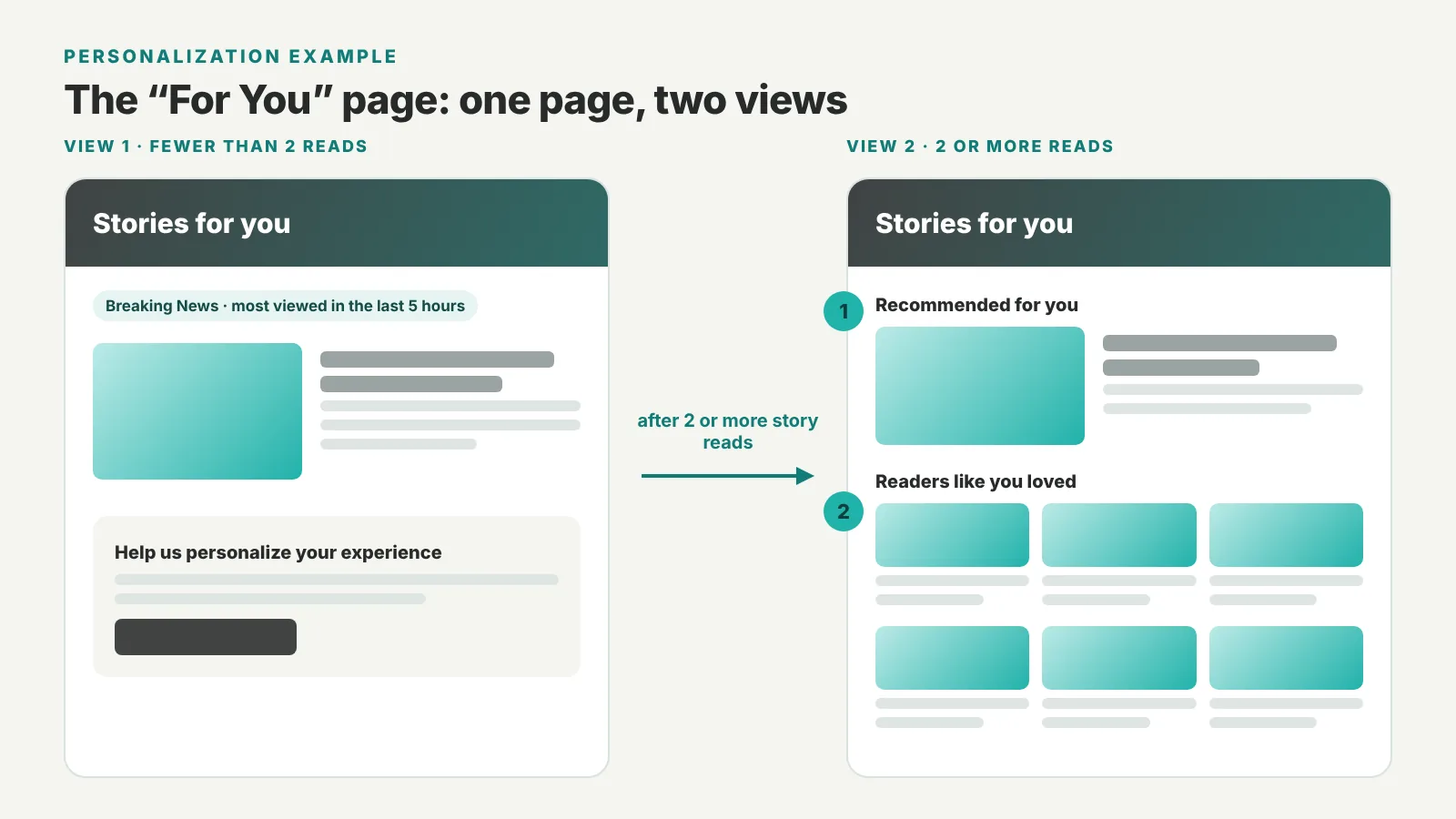
Fewer than 2 story reads: the visitor sees a single article, picked by a "Breaking News" algorithm that highlights the most-viewed article of the last 5 hours.
2 or more story reads: the visitor sees "Recommended for you," the top story matched by a collaborative filtering algorithm, followed by "Readers like you loved," the next six matches.
Collaborative filtering creates an affinity between profiles and stories: what this visitor, and visitors like them, have read. The more the university knows about a visitor, the better the match:
Anonymous visitors and known subscribers are matched on the articles they've read, and what other readers of those articles also read.
Alumni have rich profiles, including location, graduation date, generation, major, and engagement with the university, which are matched to similar alumni and what they are reading.
Prospective students, current students, and parents are matched on their career interest area and the pages they've viewed beyond the news site, such as admissions.
Employees are matched on department, type of role, and years of service.
Profiling is cumulative. An employee who is also an alumnus and a parent carries all three profiles, and is matched with others who share them. A few guardrails apply to every algorithm: only stories from the last year, never a story the visitor has already read, and no short statements or briefs.
The results
The impact showed up in both efficiency and engagement:
From 2 to 4 weeks, to in step with content. Personalized variants went from taking two to four weeks to reach production, to going into production in tandem with content creation.
1,200 alumni newsletter sign-ups in the last year that wouldn't have happened without the personalized variants.
A 700% increase in clicks on a second article after A/B testing the related articles, the images next to them, and a variety of recommendation algorithms.
Over 100 new social follows from a persona-driven social follow message.
Lessons for anyone considering consolidation
Know what can be unified today, and what still needs an integration.
Don't consolidate just for the sake of simplicity. Keep the tools that do something your platform can't.
Start with one use case that can prove value, such as a newsletter sign-up or related content, and build from there.
Grow your authors with the technology. Personalization in the CMS only pays off when content authors are enabled to use it.
Measure both sides: operational efficiency, like fewer handoffs and faster launches, and audience impact, like engagement and conversions.
In Summary
Personalization at a university has to follow one person through a lifetime of relationships. By moving personalization into SitecoreAI, this university brought customer data, personalization decisions, and content creation closer together, and put personalization directly in the hands of the people creating the content. The result: faster launches, fewer handoffs, and measurable gains in engagement.
If your organization is weighing a multi-vendor stack against a consolidated one, we'd be happy to help you work through it.