
How to Use the AI in SitecoreAI as a Content Author
Content authors are under more pressure than ever. You're expected to produce more content, across more channels, for more audience segments, all while keeping the brand authenticity and creative quality that actually drives results. At the same time, most of the AI tools in front of you are built to do one thing: generate content.
Here's the problem with that. Writing is what content authors do best. You tell creative, authentic stories with a soul. You know how to position your brand, you understand your audience, and you can speak to your business. AI that tries to do that part for you is solving the wrong problem.
SitecoreAI takes a different approach. Its agentic tools can work around your creative process instead of trying to replace it. The catch is that most content teams don't know these capabilities exist, let alone how to use them without calling a developer. So let's walk through what's in SitecoreAI for content authors, what all the new vocabulary means, and four ways you can put it to work.
Where AI actually helps content authors
When we look at where content authors struggle most, it isn't the writing. It comes down to four areas:
Content intelligence: knowing the impact of your current content with specific audiences, what's working, and what needs improvement.
Co-ideation: refining an idea for a specific audience before you invest the time to create it.
Variant generation and distribution: once the content is written, producing the versions for each channel and each personalized audience, without eating your whole week.
Content recommendations: knowing who is on the site and showing them the right content, at the right time, in the right place.
The goal is simple: leave the creativity in the hands of content authors, and let AI make sure that content reaches the right audience and delivers the highest impact.
Demystifying the building blocks
Sitecore puts AI in the hands of non-technical users through standard agents, custom agents, skills, and the Marketer MCP. That's a lot of new terms, so here's what each one means in plain language.
What is an agent?
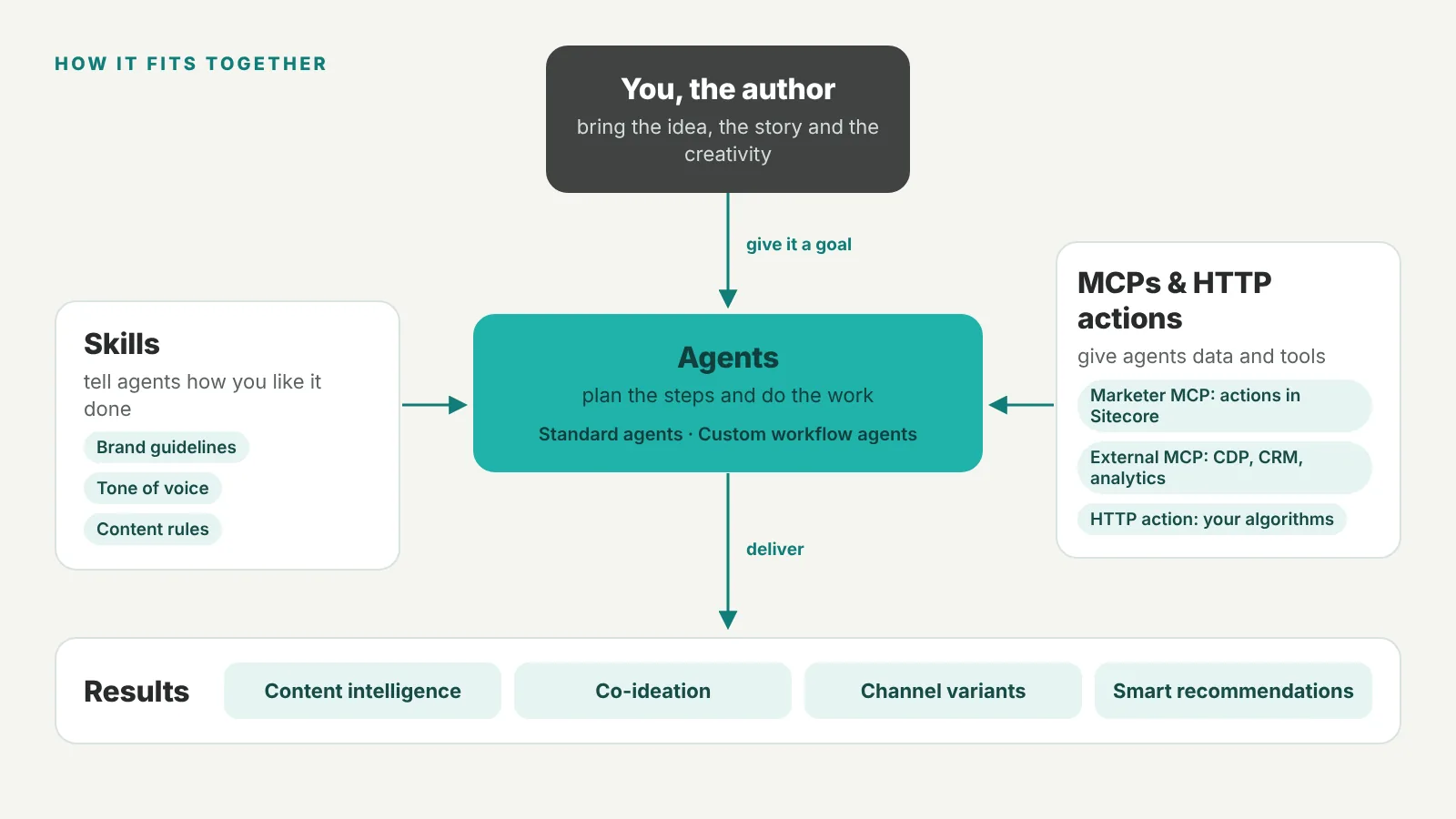
A chatbot or copilot answers questions and drafts text when you ask. An agent goes a step further: you give it a goal, and it can plan the steps, use tools, and take actions in Sitecore to get the job done. Think of it as the difference between asking a colleague for advice and handing them a task.
Standard agents vs. custom agents
Standard agents are driven by instructions you write in plain language. SitecoreAI ships with a set of prebuilt standard agents you can use today, such as the Bulk Content Generator, and you can create your own.
Custom agents are built as workflows in Agent Studio. You lay out the steps using the actions Sitecore provides, including an HTTP action that calls an outside service. Use one when the job needs to follow the same steps every time or pull in data from outside Sitecore.
What is a skill?
A skill is a reusable package of know-how that you attach to an agent. Your brand guidelines, your tone of voice, or your rules for writing a meta description can each become a skill. Write it once, and every agent that uses it follows the same playbook.
What is an MCP?
MCP stands for Model Context Protocol, an open standard for connecting AI to real tools and real data. An MCP server is like a universal adapter. SitecoreAI's Marketer MCP lets AI take actions in Sitecore for you, such as adding a component to a page. You can also connect external MCP servers, such as your CDP, CRM, or analytics, so the AI works from your customer data instead of guessing.
How they work together
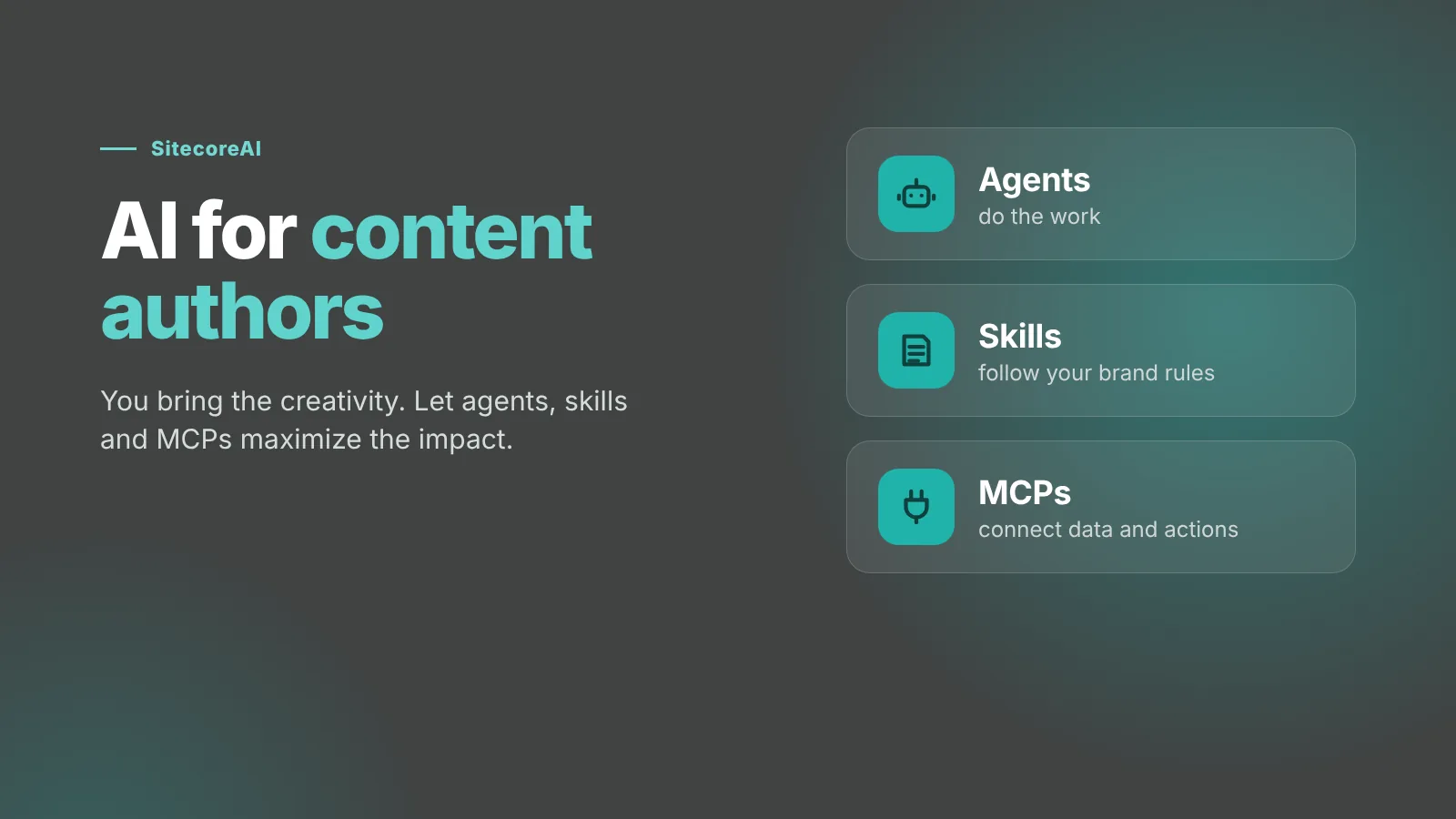
Put simply: agents do the work, skills tell them how you like it done, and MCPs give them the data and the tools to do it.
Putting it to work: 4 use cases for content authors
Each use case below pairs a content author pain point with the SitecoreAI building blocks that solve it. For each one, we've included a few questions to help you find the same opportunity in your own organization.
1) Variant generation for distribution and personalization
What it does: Takes content you've already written and produces variants tailored to different channels and audience segments.
How to build it: A skill paired with standard agents.
Start with the prebuilt standard agents. Use the Bulk Content Generator agent to create variants of an existing piece of content.
Build a skill with your brand guidelines: tone, voice, words you always use, and words you never use.
Create your own standard agent that uses that skill to generate channel and audience variants from existing content.
Ask yourself: Which content do you rewrite over and over for email, social, and the website? Which audiences would you personalize for if variants were no longer the bottleneck?
2) Content intelligence
What it does: Surfaces the impact of your existing content, so you know what's working, with whom, and what needs improvement.
How to build it: A custom workflow agent connected to an external algorithm and customer data through an HTTP action.
Build a custom agent in Agent Studio using the actions available in the workflow builder.
Add an HTTP action that sends the page content to an external service and brings back the analysis.
Run the agent on a page to see how that content is performing and where it can improve.
When to use which: If the job is mostly writing and judgment, a standard agent with a skill is usually enough. If it needs the same steps every time, or data from outside Sitecore, build a custom workflow agent.
3) Smart components for recommendations
What it does: Adds an intelligent recommendation component to a page, filled with your existing content.
How to build it: A standard agent that uses the Marketer MCP to place the component on the page. The component is connected to a recommendation algorithm that picks content from a data source, based on the profile and behavior of each visitor.
Use the Marketer MCP to ask the AI to add an existing component to a page.
Point the component at the content it should recommend from.
Let the algorithm choose what each visitor sees, so the right content shows up at the right time and in the right place.
Ask yourself: Make a list of the things you do by hand in Sitecore every week: adding components, updating pages, setting up variants. Every one of them is a candidate for the Marketer MCP.
4) Co-ideation
What it does: Helps you refine a content idea for maximum impact, and predicts how it will land with your audience before you create it.
How to build it: A custom connection to an external MCP server that brings in customer data.
Chat with the AI about a content idea before connecting anything, and note how general the answers are.
Connect the external MCP server.
Ask the same questions again. With customer data and behavior behind it, the AI can tell you whether the idea is likely to deliver for a specific audience, and help you shape it for them.
Ask yourself: Where does your customer data live today: a CDP, a CRM, your analytics? Each of those can become an MCP server that makes your AI conversations smarter.
Beyond the built-in capabilities
The prebuilt agents and skills in SitecoreAI give you value out of the box. The real strategic power, though, is how far the platform can be extended. With the HTTP action and external MCP servers, you can bring your own algorithms and your own data into SitecoreAI, so the platform grows with your use cases instead of limiting them.
In Summary
AI in SitecoreAI isn't about replacing content authors. It's about giving them a companion that handles the parts of the job that slow them down:
Agents do the work, from prebuilt standard agents to custom workflows you build yourself.
Skills make sure that work follows your brand and your rules every time.
MCPs connect the AI to Sitecore actions and to your customer data.
You bring the creativity; let AI maximize the impact. Start with one use case, such as variant generation with your brand guidelines as a skill, and build from there.